
| (18.16.12) 11.727 Northlight 60 |
Tracking the seasons
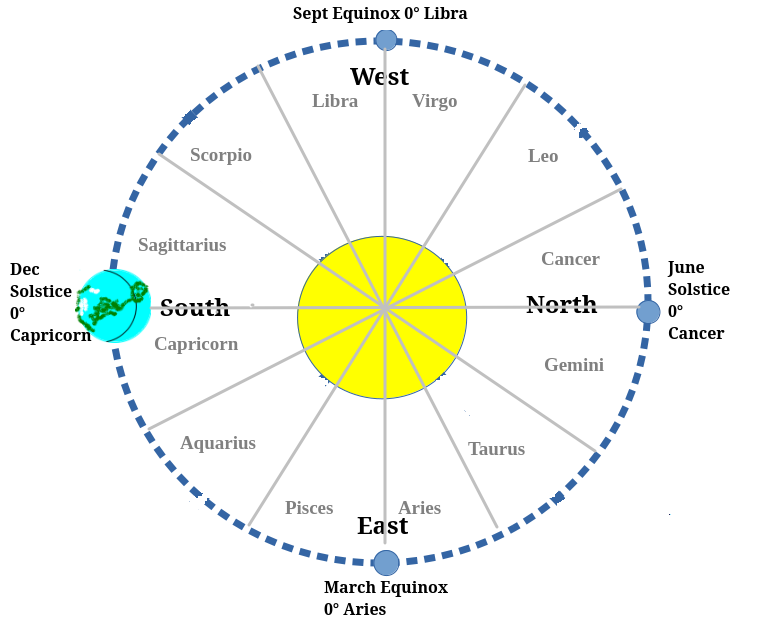
It would seem natural for an Earth-oriented calendar to track the seasons. The question is, which seasons? If it’s autumn in the Northern Hemisphere, it’s spring in the Southern Hemisphere. Meteorologists in Western countries set them on the first days of March, June, September and December. But more widespread in the West is the use of the equinoxes and solstices to indicate the start of a new season. Other systems, including traditional Irish and Chinese, have the equinoxes and solstices around the midpoints of the seasons. Some calendars in South Asia use a six-season system.
One way to look at the seasons is to see where the most direct sunlight is. It travels between the Tropics of Cancer and Capricorn, at 23.5° North or South. The most direct sunlight reaches its southernmost point, the Tropic of Capricorn at the December Solstice, and its northernmost point, the Tropic of Cancer at the June Solstice. These latitude lines get their name because Western astrologers place the Earth at 0° Capricorn and 0° Cancer on those days.
If we were to plot the Earth’s position in its orbit during the Solstices and refer to them South and North, we could then pinpoint East and West, which would happen to be the Earth’s positions at the Equinoxes, when the most direct sunlight is at the equator. Spring Equinox is at 0° Aries and Autumnal Equinox is at 0° Libra.
The quarters are named for these directions. Northlight and Southlight directly reference the sun’s most direct sunlight relative to the Earth, where as Eastlight and Westlight reference their points relative to Northlight and Southlight.
There are practical reasons for using quarters for the civil date, the main way to mark the date. First of all, it’s easier to memorize the names of four quarters rather than twelve months. Secondly, they are clear indicators of the time of the year we live in, regardless of the local seasons.
| Name of quarter | Start of quarter (where) | Start of quarter (when) | Number of days |
| Southlight | 15° Scorpio | November 7 or 8 | 89 |
| Eastlight | 15° Aquarius | February 4 or 5 | 90 or 91 days |
| Northlight | 15° Taurus | May 5-7 | 94 days |
| Westlight | 15° Leo | August 7-9 | 92 days |
When does the New Year and each quarter start?
The start of the quarters aren’t at 0°Aries, Cancer, Libra, and Capricorn, but at the halfway points between, as shown above and below. By making the solstice and equinoxes the midpoints of each quarter, we have two quarters where the most direct sunlight is at its northernmost or southernmost points, and two quarters where the most direct sunlight is closest to the equator.
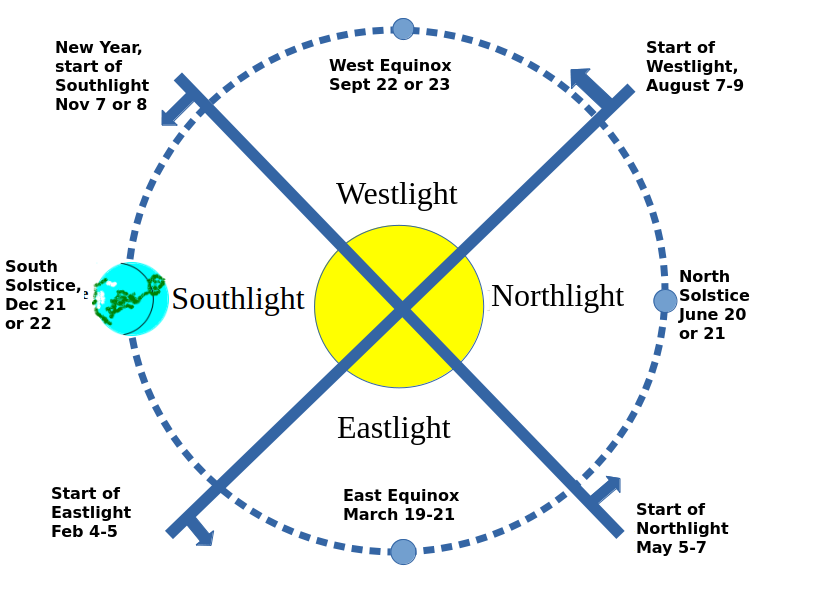
New Year’s Day on the Earth Epic Calendar is Southlight 1, which falls on either November 7 or 8. This time was chosen as the New Year because it is immediately after the harvest in the Northern Hemisphere. It can be seen as a time to turn inward and reflect on the year past and slowly start preparation for the coming year. Planting is still months away. Southlight 1 is roughly at about the same time that the ancient Celtic calendars began their new year.
Notice that the quarters have different lengths despite being appearing to be equally spaced on the circle. This is because the Earth’s orbit is slightly elliptical, so as a result, it takes longer to travel from 15° Taurus to 15° Leo than it does from 15° Scorpio to 15° Aquarius.
How the lengths of seasons change
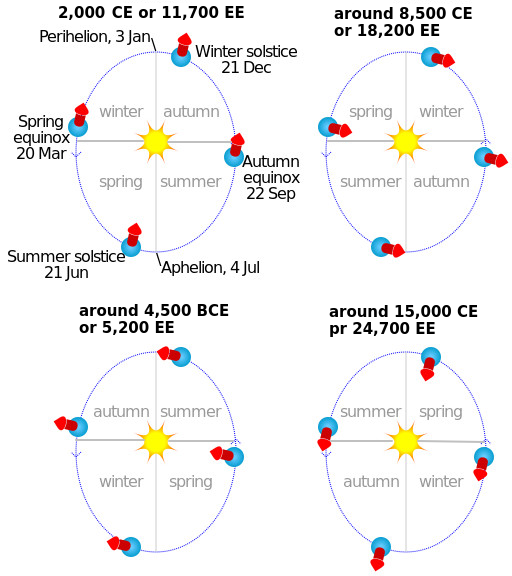
Over a period of an axial precession—roughly 26,000 years—the lengths of these quarters will rotate. In 1689 CE, Westlight became longer than Eastlight, and sometime after 4000 CE, Westlight will become the longest quarter, exceeding that of Northlight.
If you wish to continue to the Lunar Months page, click here,
If you wish to return to Basic Structure of the Calendar, click here