
When looking at the full expression of a date on the Earth Epic Calendar, the three numbers you see in the parentheses are the three largest units of time, known as the Epic Time Scales.
| (18.16.12) 11,727 Northlight 60 |
It’s tricky calculating the precise age of the Earth because scientists today estimate the Earth’s age at 4,540,000,000 years old plus or minus 50,000,000 years. Human beings simply can’t fathom the notion of millions or billions of years, but we can visualize 100 as a 10×10 grid. Thus each of the units of time below are separated by factors of 100.
Furthermore these units of time are related to significant events in human and Earth history that happen to align around the number 25, which is why each of these units are the length that they are. The units of time range in size from 25,000 years to 250 million years. As such, these numbers are in parentheses because in everyday use, people will see no need to include them–just as most people see no need to include the initials “AD” or “CE” after the year while writing the date.
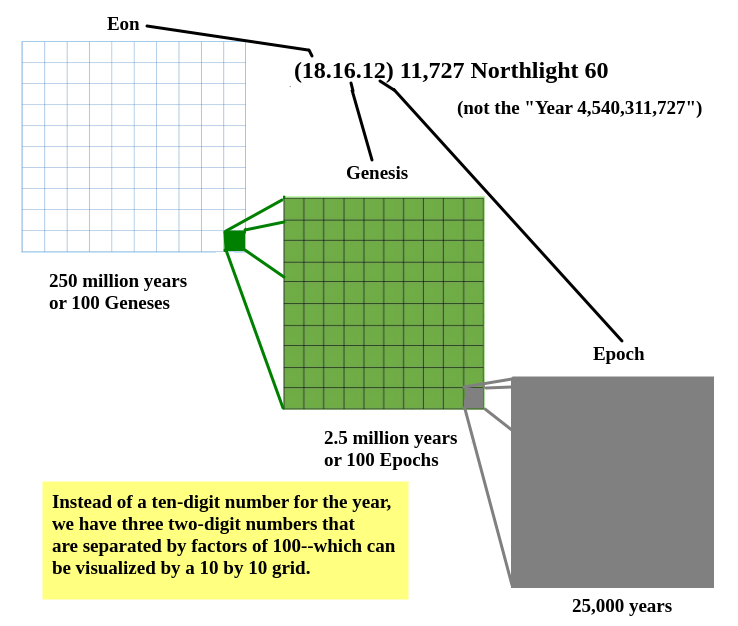
Despite the 100 million year variance in the estimated age of the Earth, the Eco-Pagan/Earth Epic Calendar bases its cycles on the assumption that the Earth was created exactly 4,540,311,700 years before 2000 CE
Why break down cycles this way? Why assume such a precise year if the estimate of the creation of the Earth varies by 100 million years?
It’s because the lengths of the Epoch, Genesis and Eon and the start of their most recent cycles are based on significant moments in Earth history. These cycles can help us gain better understanding of our Earth’s history. This makes the Calendar a remarkable Earth History teacher.
So let’s take 4,540,311,700 years before 2000 CE and break it down into time scales—known as Eons, Geneses, and Epochs.
Eon
- Length: 250 million years. This is roughly the length of a Galactic Year (the time it takes for the Solar System to orbit the Milky Way Galaxy), or the time between the advent of the dinosaurs and now.
- What Eon is it? Divide the estimated age of the the Earth as of 2000 CE–4,540,311,700–by the length of an Eon, and you’ll see we are in Eon 18 with a remainder of 40,311,700 years.
- The Cambrian Explosion started right before Eon 16 and the advent of the dinosaurs started in Eon 17
- Watch the videos about Earth 500 million years ago and Earth 200 million years ago, and you’ll see the huge difference between Eon 16 and Eon 17.
- Watch this video about the most recent Galactic Year and realize that this represents only about 6% of all of Earth’s history.
Genesis
- Length: 2.5 million years. This is roughly the time between the advent of the Quaternary Period, when the first humans (genus Homo) appeared, and the present.
- What Genesis is it?: Divide the remainder after Eon 18–40,331,700 years as of 2000 CE–by the length of a Genesis and you get 16 with a remainder of 311,700 years as of 2000 CE,
- What is the significance of the start date of the current Genesis?
- It is roughly when Homo Sapiens first appeared.
- We are still in the Quaternary Period. The advent of Homo was accompanied by the start of an ice age.
- Technically the Earth has been in a an ice age for this entire period. In the early part of the 21st century CE we are currently in an interglacial period of the current Ice Age. The last glaciation period lasted from from about 115,000 to 11,700 years ago.
Epoch
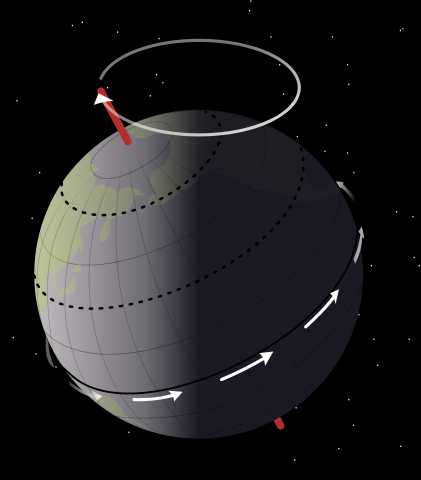
- Length: 25,000 years. The approximate length of the Axial Precession.
- The axial precession is actually the earth’s polar axis slowly rotating over that period of time but it makes a profound difference with which stars we see.
- People today talk about the transition from the Age of Pisces to the Age of Aquarius. An axial precession would be the transition through all twelve zodiac ages. (Zodiac ages aren’t part of this calendar, though.)
- The axial precession actually varies in length, and will grow longer as the moon moves further away from Earth. This is why we don’t time the Epoch to the actual axial precession.
- What Epoch is it?
- Divide the remainder after Genesis 16–311,700 years before 2000 CE–by the length of an Epoch and you get 12 with a remainder of 11,700 years before 2000 CE, or 9701 BCE.
- What is the signficance of the start of the current Epoch?
- The year 9701 BCE marked the start of the Holocene Epoch
- The beginning of the Holocene is when the last glacial period ended and the climate warmed up enough to allow human civilization to develop and flourish.
- The Holocene encompasses all of written human history, and all of the permanent human settlements brought about by the dawn of agriculture.
- The beginning of the Holocene was set in 2008 by the International Commission on Stratigraphy based on Greenland ice cores.
Thus, you get the following date for July 4, 2027: (18.16.12) 11,727 Northlight 60.
It also means that if further research changes our estimation of the age of the Earth, we can change the Eon, Genesis, or perhaps Epoch without having to change the year, since it’s unlikely that variance of our estimates will fall from 100 million years to less than 25,000. This will avoid disruption of our timekeeping, as we won’t normally need to reference what Eon, Genesis or Epoch it is.
If you wish to continue the tour with the Quarter time unit page, click here
If you wish to go back to the page discussing the basic structure of the calendar, click here.