
| (18.16.12) 11.727 Canceon 1 |
Why we have a lunar calendar
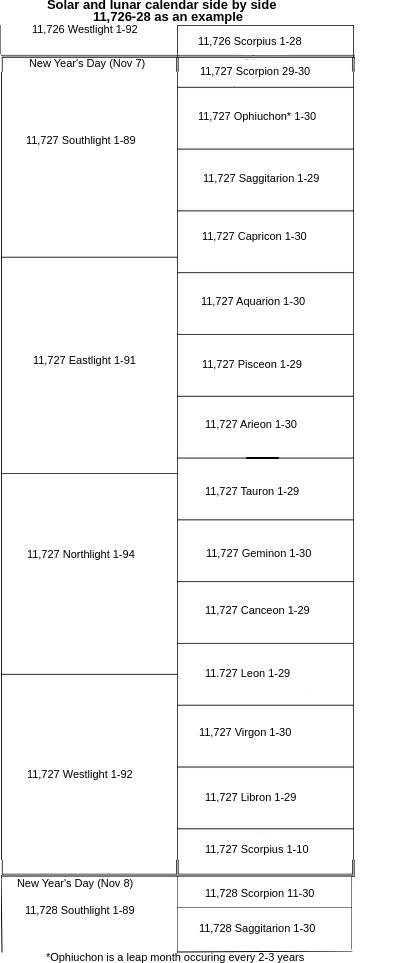
If there are already quarters tied to the solar year, why does the Eco-Pagan/Earth Epic Calendar also have a calendar with lunar months? There are two reasons.
First, the calendar’s purpose is to track Earth’s cycles. It makes sense that the calendar tracks both lunar and solar cycles. Second, months are closely tied to human culture. Many Pagans observe the new and/or full moons, and many ceremonies in many cultures are tied to these cycles, including Easter in Christianity.
The original months in ancient calendars were lunar months. But twelve lunar months only equals 354 days. Over time, various attempts were made to reconcile the solar and lunar cycles. The most common way was to insert a thirteenth month into the calendar year every two or three years to keep the months aligned with the seasons—a “lunisolar” calendar.
The Quarters are tied to the year, which makes them better for civil purposes. The Lunar month in this calendar almost always straddles the new year (with slightly different names for the parts of the month before and after the new year) , which might make it better for ceremonial purposes. But people can use the calendars however they’d like.
Some cultures have multiple calendars for multiple purposes. Many farmers in eastern parts of Asia use a separate “solar term” calendar with 24 terms per year that are more specific to the agricultural cycles. Many countries now using the Gregorian calendar often still keep their traditional calendars for cultural and ceremonial purposes.
Where the names of the months come from
The Earth’s orbit around the Sun and the Moon’s orbit around Earth aren’t aligned. For example, the second lunar month of the solar year in the Earth Epic calendar could start anytime between November 8 and December 7, which are ~30° apart in Earth’s orbit. So if the Quarter names are based on the points in Earth’s orbit, how can we do the same with lunar months?
Despite being a Muslim calendar, the Iranian Solar Hijri calendar bases its month on the zodiac. This is not because they like using astrology to predict things (quite the opposite), but it’s another convenient way to plot Earth’s orbit around the Sun. The constellations have been used to plot locations in the solar systems for millennia.
However in 127 BCE, Hipparchus discovered that because of Earth’s axial precession, the constellations seem to “move.” After this discovery, Western astrologers felt the positions of the planets were most important and so decided to keep the locations of the zodiac as they had been in the solar system– even if it didn’t align with the constellations. Vedic astrologers did the opposite–they kept the map of the solar system tied to the constellations despite them moving relative to the Earth.
The constellations have “moved” (really the Earth’s axis is what moved) about 30° (or “backwards” one sign) since 127 BCE. So while someone today might be born under the sign of Leo, the Sun relative to Earth at that point would point to the Cancer constellation.
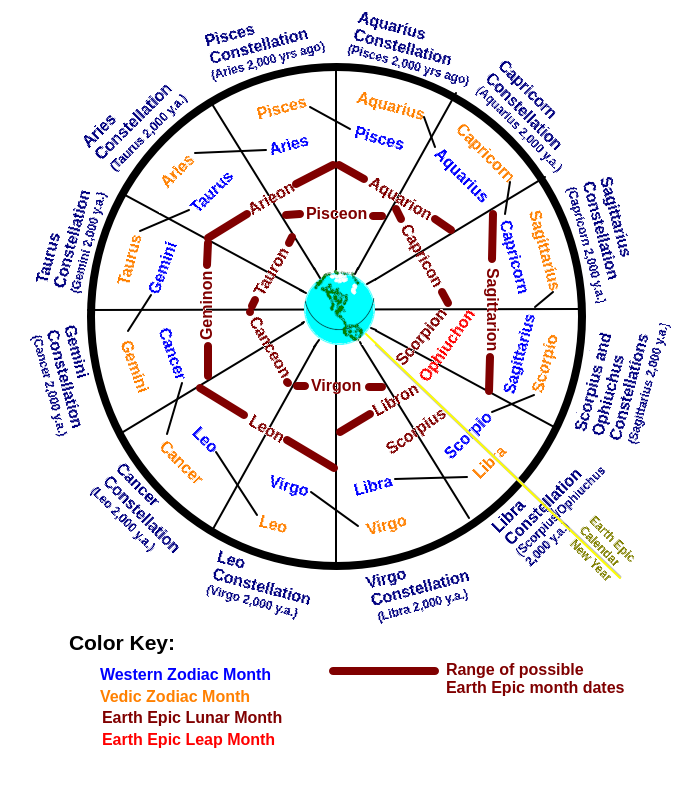
As such, at this unique point in history, if you were to combine the spans of the Vedic sign of Leo and the Western sign of Leo, you would have a span of time covering about two months. Which is roughly the span of time covering all the possible dates upon which the beginning and end of a specific lunar month can occur. So, because of this unusual alignment, we can still use the astrological signs to indicate the months despite them moving on the calendar. It should be noted that the spans of these lunar months aren’t exactly the same as the span of the Western and Vedic astrological signs put together, but they’re close.
However, to distinguish these months from the actual zodiac months, the names are slightly altered. The last syllable or last letter of each zodiac month is replaced with the suffice “-on” so people don’t confuse the lunar months with actual zodiac signs.
Scorpio is an astrological sign whose name isn’t identical with its associated constellation, which is Scorpius.3 Coincidentally, the month of Scorpio in Western astrology straddles the Earth Epic New Year. Because it straddles the New Year, the part of the Scorpio associated month prior to the New Year is named “Scorpius” and the part after the new year is named “Scorpion.”
Leap months
Since Babylonian times, humans have counted twelve zodiac signs. These are all named after constellations along the ecliptic.
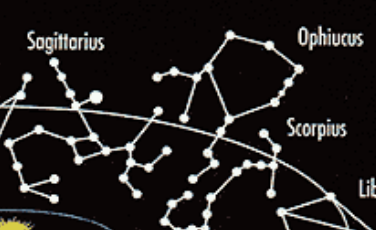
But there are actually thirteen constellations along the ecliptic. Ophiuchus is sometimes referred to as the “forgotten 13th sign of the zodiac.”6 Astrologers may divide the ecliptic into twelve equally-sized pie pieces, but the constellations in real life aren’t that neatly arranged.
Coincidentally, some solar years have 13 lunar months within, while other years have 12. As such, Ophiuchon serves as a leap month in the lunar calendar, appearing every two or three years. Ophiuchon is inserted between Scorpion and Sagittarion during those years. This year 11,727 has a lunar leap year.
<— go back to the Quarter page
go to the Week and Day page —>