
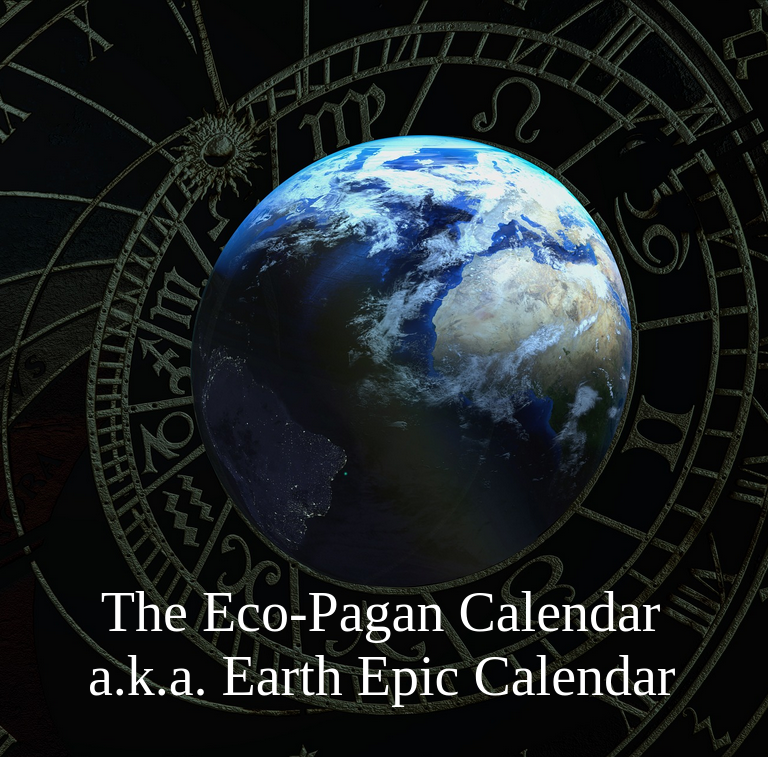
The last major change to our modern Gregorian Calendar was really made by Julius Caesar in 46 BCE. Then a monk in 525 CE changed the numbering of the year to base it on the estimated date of Jesus’s birth rather than the founding of Rome. The update introduced by Pope Gregory in 1582 CE simply subtracted three leap days every 400 years to make the years more accurate.
Since then, we’ve learned that the Earth is not the center of the Universe. Rather than believing the Earth is 6,000 years old, we are able to carbon date fossils that are hundreds of millions of years old, rocks that are four billion years old, plot the evolution of organisms and ecosystems over millions of years and know that the Earth is about 4.54 billion year old.
And we use a calendar that has changed little since Julius Caesar.
With such a narrow way of looking at things, is it any wonder that we face a climate and ecological crisis that threatens all life on this planet?
What the Eco-Pagan/Earth Epic Calendar does
The Eco-Pagan Calendar/Earth Epic Calendar–seeks to replace the Gregorian calendar with one that is culturally neutral, and reflects human history and earth history more accurately. It is more accurate, and furthermore, can serve as tool to educate people about the various cycles of the Earth, moon and sun. It has the following advantages:
- The beginning of the year is tied to an actual location in Earth’s orbit, making the length of the year much more accurate.
- A leap year is added only when it is actually needed. (It’s not always every four years.)
- The calendar can be changed with little disruption to its current structure as further information comes in about the age of the Earth
- Through this calendar, the user can learn about:
- The position of the Sun relative to the Earth
- What the axial precession is and its impact on the stars we see in the sky
- The changing lengths of each of the seasons (as defined by the solstices and equinoxes) over a period of hundreds and thousands of years
- The significance of the Holocene Era/Epoch and the Quatnerary Period that we are in.
- How long ago Homo Sapiens emerged, how long ago humans (the genus Homo) emerged, how long ago the emergence of the humans was compared to the emergence of the dinosaurs, and how the emergence of both compare to the entirety of Earth’s history.
- The approximate length of time it takes for the Solar System to rotate around the Milky Way.
The Eco-Pagan angle
It was originally called the Earth Epic Calendar because of being reflective of the entirety of Earth History. It is now also referred to as the Eco-Pagan Calendar because of its potential appeal to people who find spirituality in the Earth and her ecosystems. More about Eco-Paganism can be found here.
But you don’t have to be a Pagan in order to appreciate the calendar.